
The Social Network
A Global Body Politic

Topology: Safety in Numbers
The social network emerges out of a need for safety in numbers. The first networks became empires challenging each other for dominance and scaling outward to reduce insecurity and effect Metcalfe's Law. Within this expanding topology, distinct nodes develop. At least initially these are individual identities acting like landmarks around which we gather because of widely recognized characteristics. A node has a sense of culture or personality and holds broad appeal. Our patronage allows these nodes to extract continuous revenue and develop capital—this is the Matthew Effect.
The mass appeal of a node comes from its character—we may call it cultured. In the first instance, culture is organic, like bacteria or cancer, where growth is its purpose. In the second, it is a utility—we meet basic physiological needs, and then higher-level cultural expression demands attention. Eventually culture encodes utility as an expression of ideas of philosophy, mythology, spirituality; a script or instruction manual carried through time.
A node is a person, or today a thing with the ability to receive inputs and generate outputs that yield ease or comfort. Life becomes easier and time becomes available for whatever one wishes to use it for—that which does not entail toil or suffering.
Nodes make a reckoning of the world. They take a true account of it and communicate this with the rest of the network: Here is what I have assumed for myself and here is what I generate as a yield.
In proximity to diverse and open nodes, we cultivate sophistication and an openness to other perspectives. As well, our introverted aspects find community. Not that sources of water are absent in the vast open desert—but networks develop like the teeming spokes of eco-diversity around the hub of an oasis.
Our most significant nodes—corporate entities, academic institutions, governments, media, and associated professionals—extract much in due consideration for what they provide. They may also generate the heat and noise of conflicting signal; a general dissonance and degradation of environment as culture is generated for the sake of capital rather than for its own sake. Then they are not functioning as nodes ought to by becoming more productive over time. The purpose of information technology—a culture of intellectual capital for data networks—is to lower prices and generate ease. Instead, prices continuously rise.
Consequently, trust in them has declined precipitously. Those who work in these domains respect them, and may admire their capacity to afford sinecures, but few comprehensively trust them. Persistently high turnover and dissatisfaction may result; we default to a zero-trust posture entailing pressure and anxiety.
Individuals on the network who are not party to dominant nodes are the primary legitimate source of revenue outside of institutions. They give the network credibility and make it viable as a decentralized and distributive architecture. These are increasingly able to draw talent from the core.
It may also be a concern to the regime that independent thinkers are no longer participating in the town square of public discourse but rather choosing to tightly define their own semantic perimeters—collectives, guilds, cooperatives—people who see work as a fundamental aspect of their personality rather than a job and are happy thriving at the periphery.
Through this process—Reed's Law—true communities develop. Transcending geo-spatial boundaries: a shared code or protocol of being and belonging that binds individuals together in a space where they feel at ease. A space for stakeholders exclusively; without the need for their extractive sponsors, the passive shareholders who hold them as sharecroppers to their duty.
What appears as a kaleidoscopic pattern to some and entropic complexity to others develops over time into a genuinely appreciative pluralism—characterized by integral strength, rather than mere tolerance, as the set and setting of tribe replaces alienation. The mass of humanity need only offer simple civility and respect on the highways and byways where we transit together to our various communities.
The path on this journey is emotionally painful because it makes us vulnerable on those transit points. The instancy of social media rewards impulsivity; judgement comes quickly from those who might hide behind relative anonymity; combined with the data shared between our applications, we put a lot of ourselves out there. Knowing you are sharing everything and not minding about the reactions of others is difficult for a social animal.
We feel the emotional strain as a crisis that demands a chrysalis-like transformation for the individual and the social network alike. Necessary—if we are to persist—because only through this evolution will we find the alignment between self, community, and ecology required to make peace with our nature and each other.
Architecture: Boundedness & Alignment
If we see ourselves as nodes working in a civil framework shorn of ego, the ultimate analogy is a bee colony; the centre of which is the queen—representing anima, the sine qua non liveness of organic nature without which there is nothing. Bring this reality home to humanity and think of our Queen as Gaia, the earth itself, whose degradation surely portends the end of our species—and the decline of contentment in the meanwhile.
We can view the colony as a cooperative economic enterprise. Surrounding the queen, workers and drones maintain defense while carrying out tasks. While daily work extracts resources, it is immensely generative—human survival would be precarious without bees as pollinators. Resource extraction is a closed loop—an inherently generative act aligned with the local ecosystem, which they execute within the short-term window of the bloom.
It's the same with humans wishing to persist in a creative way. In a state of nature, having friends helps. For example, in the backcountry with inclement weather, everything becomes easier in competent company. Gathering wood, rigging tarps, filtering water—comfort comes from collaboration. Reliable company settles risk: you have to be useful, look as though you're enjoying yourself, and display a willingness to learn. Recreation is creative because it carries risk. When mindfully operating in a collaborative network, you reduce net toil and feel productivity. If conditions permit, an opportunity may even be afforded to play by deferring tasks to someone less able, to build redundancy in the group as risk mitigation.
Security requires trust founded on ability and joint effort. Roles spontaneously develop, a division of labor generates alchemy, everyone's pack gets lighter, and you make your own luck. This relies on a simple social contract: carry your own weight, or make a gestural effort as essential gratitude for being in the collective.
This matters because comfort in the wilderness has nothing to do with money. Capital, yes—the gear, technology, and know-how—but not fungible forms of money. In the wild, you are your money. On the social network, however, cash is relevant, bringing our objectives into view.
Objective: Key Performance
Many of us carry key ambitions—activities from which we expect ongoing contentment. Some we feel innately, while others rest on societal expectations. The two dovetail and diverge in ways unique to each of us.
Most of us have as objectives: education or skills acquisition; becoming homeowners and financially committed parents; intimacy, friendship, and play. However the centerpiece—the engine fueling these priorities in modern civilization—is a job.
For some, a job becomes a vocation when responsibilities align with a deep interest. Something piques our curiosity, forcing inward contemplation following which we reach deeper into that task. Anything worth doing is worth doing for free, yet here we draw a salary for the pleasure of doing it. Connectedness and flow are exhilarating—we are in vocation. This is when we are optimally creative and feel most alive.
If we're unable to generate this productivity, we at least derive symbolic capital: wealth, title, or notable achievements that others appreciate as social capital. This reputational promise then leads to new opportunities, and personal growth happens; a vocation becomes a sprawling journey with a clear purpose—a common logic you discern that others miss entirely.
Institutional careers in government, academia, or large firms in particular have offered security, but as well entailed compromise. Hierarchies require compliance to administrative processes. Blanket governance constrains agency and creativity, becoming uncomfortable for the psyche—particularly for the contemplative and sensitive.
As well, the constant flow of new talent and the nature of hierarchy forces abrasive competition for the ever fewer positions at a higher rank. This degrades collaboration as silos and cliques develop. Senior staff assume defensiveness, which proteges experience as animus; arguably their best and most courageous decamp when hierarchy affords neither creativity nor advancement and when alternative platforms offer alternative channels.
Degradation: The Cost of Centralization
Nevertheless, today's centralized nodes still represent a form of relative decentralization. Our current era pales in comparison to the arbitrary injustices once suffered by the marginalized. At the very least, these modern legal entities operate at arm's length from the state—a step in the historical devolution from total hegemony. They even go toe-to-toe with Western governments, which still have a long way to go in fostering equity, autonomy, and agency, and which—hard-pressed for funding—are often more interested in extracting financial levies.
Corporations—particularly in the information economy—wield enough structural gravity to intimidate nation-states, forcing traditional governments into reluctant compliance with the public zeitgeist. As large employers of voter-citizens acting in self-interest and with platforms to influence the rest of the population, they command presence and authority.
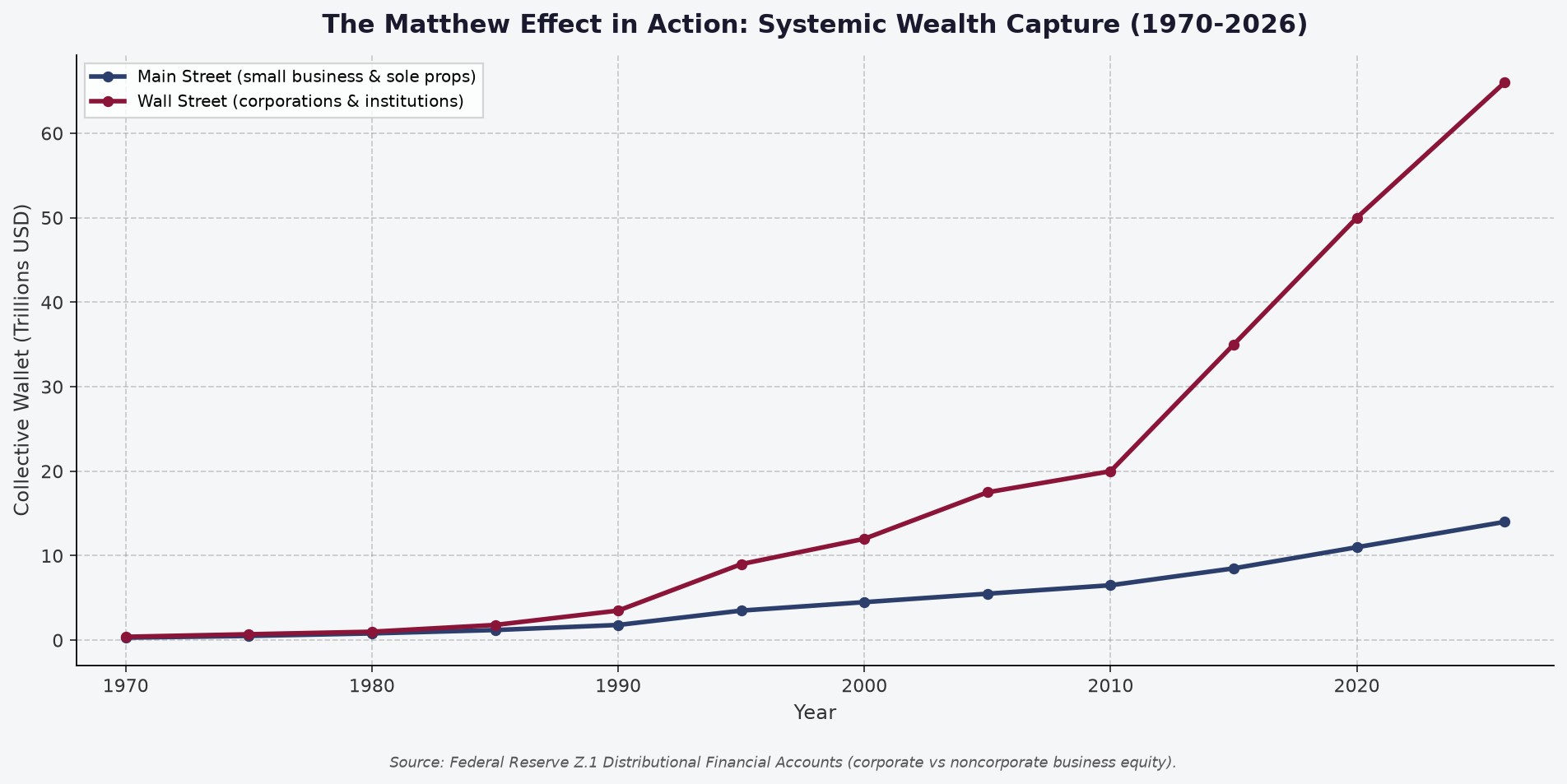
In doing so, they succeeded in monetizing engagement and centralizing capital. Today several firms account for around 30% of the capital at the largest 500 firms—this is the Matthew Effect.
For to everyone who has will more be given, and he will have an abundance. But from the one who has not, even what he has will be taken away. — Matthew 25:29
Wealth accrues to corporations and large institutions like universities. The population split between Main Street and Wall Street has kept pace—growing from 27 million vs 30 million in 1970 to 61 million vs 69 million by 2026. This diversity of our commonwealth is a cause for optimism: many people are willing to set up as small business owners.
However, the staggering variance in capital allocation reveals a severe divide—implying large internal inequity within corporations (outside behemoth tech giants where employees are exceptionally well compensated).
How does one come to terms with the alienation this extreme concentration of wealth engenders—something mirrored in the world at large? Our faith traditions are where most people go, but at a time when the law appears to be failing, the social network still holds a platform for extending genuine democracy.
Protocol: Openness Before Sovereignty
If Pascal wagered on God (even a fake one) it's because there is a limit to how much one can lose betting against him and it's baked in—you're going to die anyway; so he assumed God existed. One does not simply assume God exists without making peace with God.
One definition of the alternative, betting against God, may be going to war with reality since God is responsible for reality; seeking to coerce fate into bending to one's own will versus embracing it as opportunity is generally time-consuming, frustrating and in the long haul counterproductive.
The pagan or animist idea of God as present in all things is also a useful model if we wish to care for other people and things. The reason for doing this is obviously to reduce conflict, with the optionality perhaps of even creating friends, community and even a family.
This open approach to others facilitates at the very least discussion and the prospect of finding common ground instead of confrontation.
On the internet of things, the all-seeing, all-knowing social network is as close a proxy for God as has ever existed. Our interactions and those of the people in our proximity put our personality comprehensively online. This again offers limited downside and a lot of upside as long as one isn't confrontational at a personal level.
You may discern parallels here between these ideas and various philosophical and spiritual traditions: the flow of ki, notions of Hindu karma, and the Stoic philosophy of amor fati—as well as Zen notions of contemplation and Christ-consciousness—all of which posit that ease comes from willful contemplative surrender; a willingness to flow. This results in a constant and committed relationship with things and people; a stream of alternating introspection and introversion as cyclical as breath; and ultimately alignment between one's identity, humanity and our ecology.
From that posture, paying close attention to signal leads you to community—and this is only possible because of the Matthew Effect and the aggregation of so many people around these centralized nodes. This is Reed's Law in action: the gravitational pull of these platforms lay in the intoxicating number of even radical sub-groups that we may form to express identity or reject arbitrary social norms for their own sake. Guided by our innate qualities, we navigate this nodality to find both meaning in community and an opportunity to reject and demonstrate against conformism and compliance.
What openness makes possible, self-sovereign identity makes durable.
Sovereign Identity
We may appear to have agency, freedom, and autonomy—and many of us who are fortunate to live in relatively free societies and have accumulated sufficient capital actually do.
Many of us feel inexorably pulled by the body politic's collective will to comply as engagement-driven algorithms subtly steer our actions toward consumption. We have become part of a collective metabolism where giants harvest our attention and data to feed the network's growth—through profit which accrues to them. Alienation has set in as the constraints of civilization feel ever tighter while leaving us disappointed by its minimum viable culture—something satisfactory but scarcely sustainable.
Can't you see a giant walks among you
Seeing through your petty lives?
Do you think I do these things for real?
I do these things just so I survive
And you know I will survive~ Pulp (I Spy)
Humanity's destiny is to be accountable for our planet. The criterion is assuming a responsibility for affording a basic standard of care for our ecology and biodiversity. This in my view entails the application of behaviours which in time will govern the social network and achieve balance autonomously through a broad trust-based distribution of capital.
We are at a stage where we may define identity ourselves and so fully represent ourselves in a whole way instead of as a collection of fragments we distribute across the networks at the various nodes upon it. This semantic perimeter of identity embodied—a Semper Idem—would be a tell or a mound of data the sequence of our interactions builds stone by stone on a transparent but publicly available network; stable yet forever evolving.
Like our wearable devices that filter data analytically to provide actionable insights, so too will on-chain identity. It will allow you to harvest key insights and share them as you decide; information about how you interact with the world; a relationship whose outcomes—whether in the particular or aggregate—you may wish to improve. These data may furnish institutions with the ability to financially or otherwise incentivize choices that benefit everyone; nudge us into governing ourselves in the real world but through an on-chain social network made of self-sovereign nodes, effective because they are a complete and holistic impression of you.
For two decades, this data has fueled a Matthew Effect for firms such as Meta, Alphabet, and Amazon, allowing their initial advantages in data aggregation to exponentially compound over time. They use this to preferentially place consumer products and services in front of us and not necessarily in a way that is objectively in our interests as our data traverse the network through their centralized nodes.
Instead each of us as objective nodes could allow data to traverse on protocols between us as we assess this data and route it objectively and based on the alignment of our interests; in this way we may then finally get through to each other and resonate where we should rather than just wherever we can in order to get by.
Clearly our social network is not distributive and we see that in the broad and persistent disparities in wealth and incomes both within western societies such as Canada and the United States themselves and as well the post-colonial disparity between the North and the South, something exacerbated by persistent geo-political conflict between East and West. These are tectonic pressures of networks at their largest scale as our largest semantic perimeters vie for economic pre-eminence which seeks wealth effects at another's expense instead of examining how their own architecture might be more efficient.
Point: Treasury of the Commons
Good people are everywhere doing the best they can while maintaining the thin red lines of their boundaries whether they are inside or outside a perimeter. The giants are institutions and the personalities whose identities are deeply tied to brands. They feel conflicted between their machinery and humanity as they make often difficult decisions as they seek the greatest happiness for the greatest number; one that will seem harsh and arbitrary to the affected but, from their perspective, necessary for some greater project to survive in conditions that are not entirely in their control.
In the discussion around some or other issue how we come together matters. The word discuss itself implies that we are around a thing rather than facing off across the aisle as though to pull it or some part of it settled in a compromise. In this conversation we are never equals in any sense—not to each other; we are not each other. However, to someone looking on objectively, in fundamental or basic respects we are equivalents. In any case the discussion bears fruit only when openness and candour imbue it; otherwise mistrust will persist after what becomes an atomistic conversation rather than an ongoing history of how we roll together with the commonwealth.
This by the way is the esoteric meaning of yoga's Vitarka or discussion mudra and in the Advaita Vedanta tradition, one which many might call atheist because it does not separate us from God. From this lens God emanates through all of us as one: The tradition is a monist one wherein all our works flow to the Treasury of the Commons.
The data is immutable (soul-bound). What matters is whether people are finding meaning in their work and whether the motivation and curiosity are intrinsic. Analytics can tell a lot more about how you engage with work than how quickly you complete it. Data can reveal the depth to which you are willing to take any number of interesting detours relevant to understanding why you're doing the work that is in front of you. This is actionable data with optionality—whether a given domain retains you or not.
Institutional Decay and Protocol
This isn't necessarily to the benefit of any institution: it would prefer all else equal outcomes it can transparently defend—these are also generally the optimal ones. Indeed the whole idea of KPIs (key performance indicators) concerns the matter of rolling performance indices up the corporeal hierarchy so as to assess what is and is not working productively. Alternatively some sort of mechanism that assesses the 'downward' investment of capital against upward generation of yield. Emergent proof of stake protocols can do just that through on-chain self-sovereign identity, while yet allowing talent to express to the rest of the world how they in particular are responsible—since chain expresses attributable value much like a soul-bound token in gaming. You claimed a salary so you wouldn't take those tokens with you. Your clan wouldn't appreciate that, but you still express your relative credibility—a deterministic account from which others may infer trust. That's what matters.
This sets up an interesting challenge based on incumbent frameworks which are still somewhat analog: not just off-chain and proprietary but also subject to legal terms that allow considerable discretion on what a company needs to disclose concerning its employees, former employees, vendors and contractors. They will naturally disclose only what they are legally bound to disclose; generally the balance weighs in the favour of company simply because of their heft in a market democracy. Such is the reality of political economy versus the theoretical and abstracted free market economics modeled by Paul Samuelson et al. the better part of a century ago; that in a world where a corporation has legal status as a person, in purely utilitarian terms the interests of a single person who is actual human doesn't really count for much.
There's not much one can do but accept that reality as an imperfect situation and one we improve upon if possible. For an ordinary Canadian or Briton it's at least an improvement over the Del Monte and Chiquita economics of a Central American country (whose poor bargaining position is the origin of the Yankee slur Banana Republic) or say the corporate governance on display during the 1980s in Bhopal India where sloppy compliance led to the death of thousands of ordinary workers.
The stakes are not nearly so high in the beige offices where we do so-called white collar work. At most, legal entities here are concerned with protecting their creative kernel—copyright, patent and the top talent in whose hands it works the best; if necessary with non-compete provisions but where possible generous salaries, allowances and performance-index equity options.
This is why we see arising alienation within our institutions. The malaise concerning government, academia and journalism is well-covered but where it really hit home is the limited liability corporation.
A firm's revenue in a given period is finite and the firm devotes an ever greater portion of its income to paying its senior board-facing coterie. A deteriorating Gini coefficient best illustrates internal income inequality within the corporation—a measure wherein a 1:1 ratio implies perfect equality with all employees earning the same salary: in 1965, a principal executive earned roughly 21 times the average wage but by 2024, that ratio had surged to 285:1. The extreme outlier in this trend is Starbucks, where the CEO’s compensation once reached a staggering 6,666 times the pay of the average employee.
This is an unfolding crisis in fundamental inequity and it drives defection from all of society's core institutions in a disorderly and inchoate fashion. My own sense is that we scarcely differentiate economic activity from other aspects of life as we return to creating product in guild-like fashion as communities of interest emerge.
However the evolution to that distant vision or model is only just beginning and our institutions will need to begin adopting emergent protocols that will facilitate this transition or even just allow these institutions to persist on a sounder financial footing. The insight of transparent flow is genuinely creative and we should herald it, not fear it. Restore that flow to the body politic and Calling returns to the network.
The effect of the successful adventure of the hero is the unlocking and release again of the flow of life into the body of the world. The miracle of this flow may be represented in physical terms as a circulation of food substance, dynamically as a streaming of energy, or spirituality as a manifestation of grace. Such varieties of image alternate easily, representing three degrees of condensation of the one life force... Grace, food substance, energy: these pour into the living world and wherever they fail, life decomposes into death.
~ Joseph Campbell