Areté
Virtue
Ragnarök
I introduce tangentially the duel between Giants and God. This is a dialectic model and not true in a scientific sense but it provides nonetheless a lens through which reality is perceived and governed. Ragnarök is the catastrophic apocalypse in Norse mythology. It is a foretold sequence of events—that ends the world and leads to its subsequent rebirth typical of cyclicality.
Think of Giants as the celebrity personalities who dominate society including formal governance through social media and through narrative. Influence is earthly power and it is paid for by money to generate money. Now think of God as virtue or the divine within ordinary people who quietly go about their lives enjoying its ordinary pleasure with humility. The greeting namaste is the connection of that divine; the protocol to initiate an interface conversation; and it generally requires neither a priest nor a king to moderate that conversation.
Between these two is the accord—or increasingly in current times the discord—dictating the tone and content of the conversation. Primarily the current discord on the social network comes down to disappointment as extravagant commitments are made by Giants to be agents of positive change. They wield considerable power through office but execution often comes down to the delegation of responsibility to a multitude of people whose alignment and productivity cannot always be managed against the firm fixed terms and conditions marketed politically or commercially.
All of us believe in the power of truth, utility and beauty. This takes place in a pavilion whose azure ceiling is held aloft by four pillars of virtue: intelligence, capital, identity and governance. In my modeling of this equation I refer to it as the Dial Square with π being central to the solution simply because our lives have a cyclicality or seasonality that regulates our actions and behavior.
Virtue: Reality in Utility
All of which to explain the concept of areté (ἀρετή) or virtue—that matter concerning what it means for us to say that a thing is good. This question is pertinent today as the use of coercive power by giants begins to lose its grip; largely because ordinary folk now have leisure—the wherewithal to explore and contemplate reality; perhaps most obviously through tools online that provide good data with immediacy. This allows them to challenge and hold accountable institutional power because arbitrary coercive force is very difficult to apply in a liberal democracy against those who do no harm to others. This acts as an explanatory propaganda device (satyagraha)—a form of asymmetric challenge which relishes and embraces what the regime offers in the way of discomfort because it is so nourishing to the soul.
Giants are those who, through capital, express hard coercive power by controlling the institutions that dominate their broader semantic perimeters, using them as utilities to influence or manipulate the course of events. In this way, giants seek to change the world—always for the better. Their path is invariably paved with good intentions but execution is inherently impersonal by dint of the sheer scale at which power is being applied. Contracts and, most fundamentally the law are the mechanisms by which behavior is aligned.
Utility at scale is always crudely utilitarian—cold and institutional—where individual identity fades into uniformity. Consequently, it is virtually impossible to show preferences and bias in a regime that philosophically opposes arbitrary privilege (democracy) without a regime itself losing credibility. Once a regime's credibility is profoundly compromised, exercising arbitrary power with impunity becomes a flex. At the other end is the militant, efficient and expedient, yet utterly arbitrary, Thanos of the Marvel Universe. To Thanos, our collective, fearful, extractive, and hedonic consumption demands a reckoning. Ordinary people and their things are merely inventory in this calculation. At the same time any objection to pledging loyalty to incumbent institutions is scorned. Anarchism in particular is the acknowledgement that we must evolve and begin to look at the whole world as one's country.
God in mythology is felt as reverence towards that one unfathomable thing of unquestioned eminence—creation. It is felt as the natural order created as life itself. In Christian tradition that eminence is the holy spirit expressed as soft-power (virtue or areté). In the Hindu tradition these are truth (satyam) constantly transmuted through some thing with utility (shivam) into beauty (sundaram). Humanity's relative maturity in creation demands that it assume the responsibility of being its custodian and guardian.
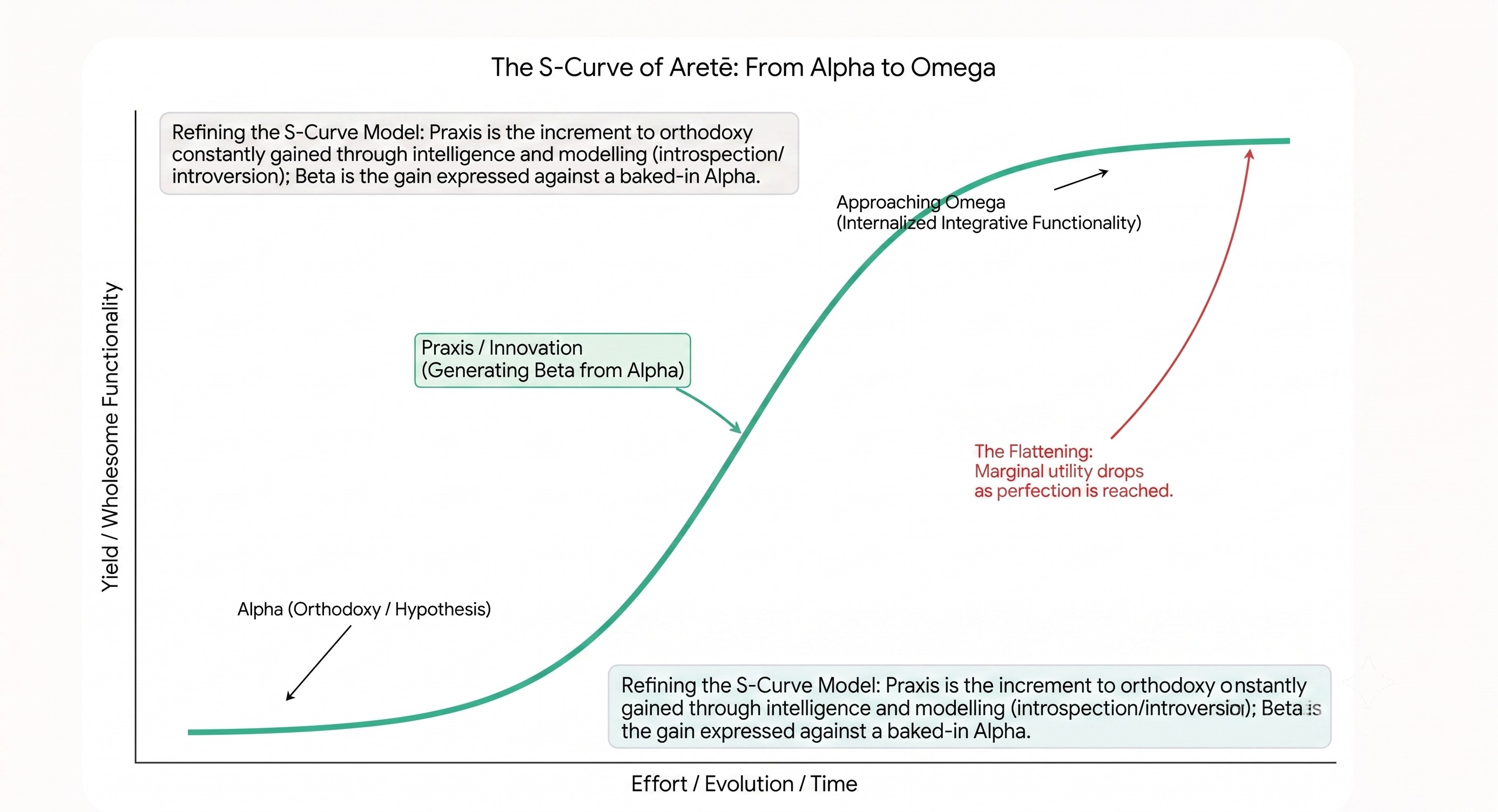
In modern software engineering we use A/B testing to objectively prove a hypothesized innovation as we continue our journey towards Omega—wholesome internalized integrative functionality. In our contemporary culture the relationship between Odin's sons Thor and Loki is the dance between orthodoxy (might makes right) and praxis (playful exploration) respectively. Fluidity makes praxis operative at a level that is almost inadvertently creative. Praxis is a deliberate acknowledgement of the power fluidity lends to an otherwise rigid orthodoxy. It requires that one deliberately chooses to register reality as just data and through the experience of a sometimes turbulent flow develop virtue or areté. This is the quality that enables contentment because it derives comfort from discomfort. A process we know as hormesis.
I use the term areté because of its linguistic personality; an almost arbitrary proximity to the French word arrêt, which means to arrest oneself or stop. To desist is almost always every bit as important as commencing something when one endeavors to cultivate virtue.
Areté and Law
Law, in the sense that concerns me here, administrative guidance, is best expressed via negativa: by its removal from the lives of ordinary people who behave maturely and may therefore be left alone to live as they see fit. The mature, self-possessed human being, confronted with gross intrusion upon agency by the coercive state, may react with self-destruction—to put an end to matters and make it personal. For such a person it is better to live free or die. The deeper matter is autonomy: the capacity to live well, free from arbitrary and coercive authority, and free from giants and the machina animus that perpetuates control by inducing behavior contrary to your self-interest. Understanding self-interest is required to sustain good health and to project that sustainability into Creation.
By Virtue of Being
Our autonomy is impinged upon by needs; food, clothing and shelter. Within your command however is the opportunity to save a surplus to fund your future and so to secure your autonomy. This was undermined in 2008 when the United States added a nominal 1.2 Trillion dollars to restore liquidity after a bout of malinvestment. Following this debasement the opportunities to invest in real-world yield bearing assets was lost. This debasement has decisively undermined the dollar regime's credibility and legitimacy.
In the aftermath protocols emerged to secure capital decisively beyond a hegemon's caprice. It is globally distributed and offers any regime the opportunity to secure productive outcomes for its people. The giants and their Leviathan find it harder to impinge upon the autonomy of a person who can exit a system which arbitrarily assigns a price for money (the interest rate). No threat is greater to our environment than the inflation (masked as money debasement) of the giants' incumbent system.
Reality Bites
If you are to question authority with any degree of credibility it's because you have a broad enough perspective to be utterly decisive in making the call; you have watched enough of the information for a long enough time. So you pivot hard towards the prospect of a virtuous reality and autonomy.
I was introduced to Areté by Kitto via Robert Pirsig in Zen and the Art of Motorcycle Maintenance in my early twenties as I came of age steeped in the social sciences; and then pivoted towards finance and information technology, to understand in practice rather than theory how the gap between truth and beauty might be better minded.
"Thus the hero of Odyssey is...an excellent all-rounder; He has surpassing areté; an efficiency which exists, not in one department of life, but in life itself." ~ H.D.F. Kitto
This is important at key cyclical moments; turnings where capital has been debased. We have solved for this considerably by making market data freely available and many individuals exploit this data. However structural impediments still have communities—those whose aim is something more than material prosperity; ethical innovation, civic projects, open-source culture—at a disadvantage because markets optimize for wealth capture, liquidity, and efficiency, not for ethics, creativity, or shared social value. Greater autonomy from incumbent market-driven systems helps address this.
Architecture of Decay
"For Zeus, who views the wide world, takes away half a man's areté on the day when slavery comes upon him." — The Odyssey, Book 17, line 322
Virtue is a key concept in human-centric architectures that aim to scale human interaction. The aesthetic quality of the outcome is critical and virtue ensures that competition is aesthetically acceptable and that functionality follows only good form. Virtue can be seen as the practice of turning the competitive impulse upon oneself to cultivate meaningful growth.
A slave is one who has forfeit control of their own life. They chose a life of a kind instead of life with autonomy. For both master and slave opportunity to cultivate areté has been removed. For the victor comes the long Faustian bargain. They lose their autonomy incrementally by first surrendering the opportunity to express themselves as basic human beings; it begins surreptitiously as they demur on menial tasks. In every sense they become removed from reality. In the modern world this tendency has spread to ordinary folk who undergo a process of D.E.C.A.Y (dutifully executing conventional activities yieldlessly). Some kind of life is better than nothing and they content themselves with a place in a pyramid.
H.G. Wells imagines a London where most people have become passive dependents on vast, automated systems, while a small elite governs through mechanized convenience. Rulers live lives entirely outsourced to institutions and machines—leaving them spiritually empty and physically enervated. Outsourcing human responsibility produces a form of living death.
“The men of the upper world were scarcely men at all, but effigies of comfort, pale with inactivity and sated pleasure.”
In Atlas Shrugged, the world is populated by those who demand results without responsibility, and those who produce value withdraw from the stage entirely. Systems grind on only through ritual and mimicry; rules are enforced without understanding, policies enacted without efficacy.
“The motor of the world had ceased to turn; the men and women in offices were only the echoes of the hands that once had built it.”
Dependence breeds decay. Power is no longer a function of capability but of ritualized assertion. John Galt encourages the world’s producers to withdraw from a system that exploits their productivity without respect for competence, which amounts to acknowledging and respecting his vision and objective—the cause and the mission—not his ego.
Entropy of Virtue
The quality of a regime's money dictates the security and comfort it can afford. De facto when money has lost its foundation neither security nor comfort can be bought. Judicial systems creak under the weight of codes defined to protect both property and person where increasingly the former has priority over the latter. Disparity in outcome is self-evidently untenable and so increasingly even the performative elements of their authority fail to impress us.
Giants holding tenuously to power are now willing to do anything to anyone to protect their station in society. They have come to believe they are indispensable; that ordinary people in the world will fail to live good lives without them. When ordinary people express autonomy in ways that are aesthetically appealing it is a challenge to their authority and dominance and their system will resist.
In Tolkien's The Lord of the Rings, some want to be left to quietly live untroubled by the cares of the great world. Others, like Aragorn, roam to assess the evolving world away from the fray. He withdraws to the periphery, returning when the world of men need him. The incumbent system is represented by the arrogant and complacently corrupt Denethor II of Gondor and by the decrepit Théoden of Rohan. Both resist reform until it is almost too late.
The Fellowship forms to challenge this incumbency from one side with virtue while a nihilist anti-vision challenges from another—an alliance forged of Sauron. Maya, in Hinduism, is the cosmic veil concealing the true nature of reality. It has grown dense, now capable of coercive gravitational pull. The maia Sauron joins forces with the powerful wizard Saruman. Together they represent competence and power directed in the interests of a collective veil of ignorance. Theirs is a fierce puritanical vision shorn of all empathy.
Aragorn's peers Boromir and Faramir have virtue, loyalty and heroism but lack the ranger Aragorn's broad scope and vision. He has the objective perspective to assess the gap between truth and beauty, and know it to be profound when the two diverge. Legolas is a stalwart ally from a tribe with equally broad insight. Meanwhile the hobbits and their dwarf cousin Gimli add a sense of joy and play to Boromir's strength, steel and superficially aesthetic authority. They are quietly marshalled by Gandalf. What sets the Fellowship apart is their sense of mortality. They will die—that much they know to be true—and it is the defining quality of all that lives.
The uncompromising quality that sets Aragorn apart is vision borne of observation and quiet introspection. When the time came, the Fellowship emerged as a coalition of the willing and bootstrapped; those with sufficient courage and intelligence to refine and reset their loyalty as they gained data. The quiet corruption of the ring is a barbarous relic—a shiny ornament for the ravenous. The shards of Narsil, made of base metals, represent true legacy. Unadulterated and functional.
The Yield of Civilization
Those who question the legitimacy of incumbent institutions and the Sovereign recognize that priorities have been inverted. Value itself—once rooted in enduring culture and the shared pursuit of truth—has been reduced to “the price one pays.” This inversion has made what was once priceless—autonomy, craft, permanence—cheap, and what was once trivial—speculation, image, novelty—exorbitant. The inverted yield curve is not merely an economic anomaly; it is the symptom of a civilization that no longer knows how to value time.
The only enduring work worth building is oneself. The Stone Rose: the cultivation of identity, virtue, and capability. The truly free—those who see through the coercion of arbitrary authority—seize the day to live as they dream.
There are four core arguments passed into a self-sovereign character. Each additive to the next to create the overarching dynamic calculus of the parts—Governance:
-
Intelligence: The ability to apply reason and empathy to discover a starting point: Truth
-
Capital: The ability and wherewithal to care for and sustain things: Utility
-
Identity: An ever-evolving understanding of one's place in the world: Beauty or Firmness
-
Governance: The perimeter of scope (a function) which combines and squares the above elements without externalizing a cost either to the commons or to other semantic perimeters but on the contrary may be an amendment to them.
To govern oneself first and then radiate outwards with positive agency without cost to yourself in ethereal terms (emotional, intellectual and spiritual) to break the spell of the illusion (maya), absorb the friction of the transition, and stand as a functional pillar holding up the world by simply refusing to be compromised by it.