
Macauley's Favorite Bastard
The Making of Ashit Patel
Kid A
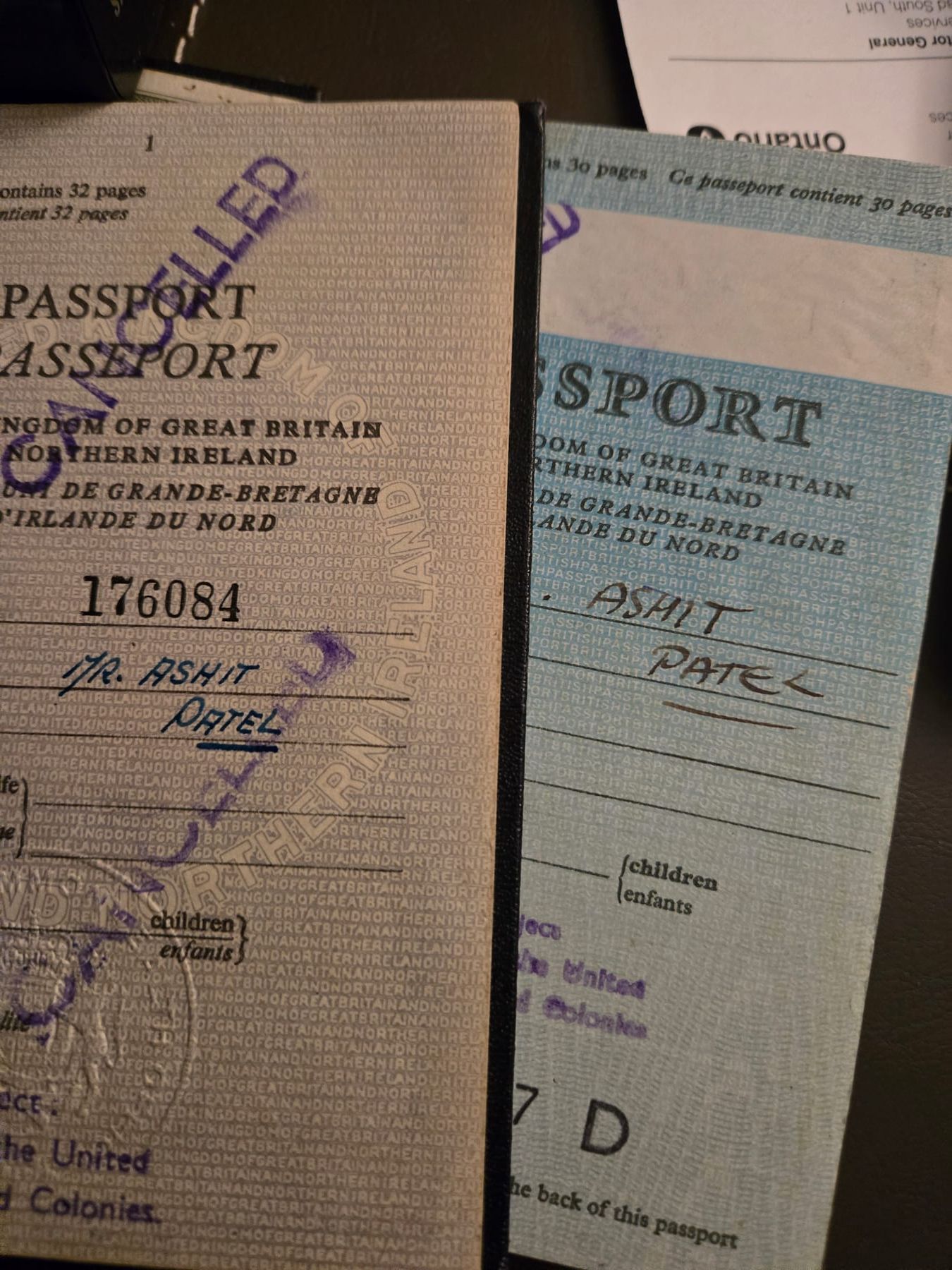
The clerks at the passport office started it. In my earliest passports they set it down, underlined: I was to be a tel (תֵּל). They came, in those days, from the aristocratic families, and likely knew something of mine. If not they themselves then their superiors. They and any number might plausibly be interested in knowing what I was all about. For starters, what an interesting name the young lad has, they might have thought. The doctor attending my birth, startled by the name he was asked to put down, decided he would instead prefer to forever call me Alfred.
A little older I'd make a funny face as he called out to me on the street outside our shop. The name was antiquated and unfashionable by the 1970s and besides, I quite liked mine for all the grief I got for it. Now though, getting on as I am and growing more introspective with it, Alfred brings to mind that King of Wessex who first brought England together.
A tel is what the Levantine world calls those low, deliberate mounds that are not hills but the compressed sediment of successive civilisations — each one building on the ruins of what came before. They rise not through geology but through history. Conquest, abandonment, reconstruction, occupation: each layer pressed down until the whole looks, from a distance, like a plain hill — of earth.
Data science has the ring of modernity about it but it is as old as those tels. As long as we've had civilizations and the money which courses through them to generate progress, we've kept records about who owed what to whom. And as well how money came to exist. Who for example generated its original value, when, where and how? Even just to entertain ourselves we have long reveled over interesting patterns in the stream of information that currency generates as it flowed through civilization and wondered incredulously at the synchronicity with which our stars seem to align to dictate some deeper significance or meaning.
Even in the mundane sense of statistics, few things in England are as storied as the Domesday Book. That first gathering of statistics by the Norman conqueror William I who quickly set about the gathering of the inland revenue required to permanently establish himself as England's ruler shortly his arrival in 1066.
Everyone Everyone is so near
Everyone has got the fear It's holding on It's holding on
~ Radiohead (The National Anthem)
Getting back though to the stream of data which resulted in my own sense of being English, there has always been a bifurcation in the way the Hindu was received in England and broadly through Europe and in the Americas. At the street amidst what a professor of mine at Western called The Great Unwashed there is sometimes an overt racism or alternatively a quiet passive aggressive hostility driven by suspicion; of a so-called model minority with unrelenting ambition, work ethic and consequently swift upward mobility. This must have felt particularly threatening and offensive in the 1970s when skiving became an aspect of working class solidarity and amidst the insecurity of middle class unemployment.
Among Europe's intellectual elite however Indian culture has long held a deep fascination and the subcontinent has been a part of the European imagination since Roman times when the importation of luxuries (pepper — known as "Black Gold" — cinnamon, silk, pearls, ivory) and the counterparty transference of gold and silver first began to strain imperial coffers.
More recently they have seen Indian traditions as an ascetic antidote to materialistic consumerism. In the late 18th century, when translations of Sanskrit texts like the Bhagavad Gita and the Upanishads first reached Europe, German romantics reacted with the same fascination as the American transcendentalists Thoreau, Emerson and Whitman who saw in it some kind of hybrid combination of the West's structural philosophy; ones rooted in its three primary faiths and as well as Aristotelian and Greco-Roman stoic traditions and indigenous American animism and anarchism:
In the morning I bathe my intellect in the stupendous and cosmogonal philosophy of the Bhagavad Gita, since whose composition years of the gods have elapsed, and in comparison with which our modern world and its literature seem puny and trivial.
~ Thoreau
Thoreau, who arguably began the environmental movement, was also a sharp critic of what we would now call fast fashion:
As for clothing, perhaps we are led oftener by the love of novelty, and a regard for the opinions of men, in procuring it, than by a true utility....every generation laughs at the old fashions, but follows religiously the new.
Meanwhile in Europe Goethe wrote poetry to Shakuntala, while Arthur Schopenhauer viewed Vedic philosophy as an antidote to Western decay and debasement.
German academics pioneered Indology (the formal study of Indian history and languages); and when linguists discovered that Sanskrit shared deep, systemic roots with Latin, Greek, Persian and Germanic linguistic currents, they thought they had mapped the original migratory flow of human civilization.
About this time the now heavily loaded term Aryan came into popular usage. Derived from the Sanskrit Arya, the word simply means elevated in a noble or spiritual sense; which is to say cultured and sophisticated for who else through history has the time to become learned but the nobility from whose ranks came for example the clergy whose primary objective it was to simply read language and carry forward culture and as well to see the sheer commonality that pervades the human experience - something which is almost indescribable and must be experienced first-hand to be truly understood.
In a related sense too Nazi Germany's darker obsession with India looms large in my life. I was born just twenty-five years after the end of World War II. Hitler's deputy Rudolf Hess believed that Europe's ancient tribes shared a biological lineage with the creators of (my) Vedic civilization, while Heinrich Himmler, the head of the SS, kept a copy of the Bhagavad Gita with him at all times.
That war was meant to be a final settling of accounts but as Orwell prophesied we carried on afterwards as we were, merely chopping and changing our roster of heroes and zeroes amidst a forgetfulness of being that recalls what else but fast fashion.
As a child raised on a steady diet of war films and the media's obsession with the fringe machinations of the National Front I would gaze at depictions of the swastika and wonder why they should come to be on display all around our home and in our traditions and rites of passage, but as well at the same time be displayed on the paraphernalia of those who seemed so hostile to human commonality. Now, that said I was quite taken with the stark symbology of those colors — red, black, and white — a simple and unspoken coming together of humanity's conflicts and currents.
Rule Britannia: A Measure of The English
In the 1700s the British Aristocracy arrived in India as commanding officers to form a robust commercial bulwark against the challenges of their Imperial rivals — the Portuguese and French in particular — both of whom held outpost in Goa and Pondicherry respectively. All the imperial powers arrived for the same reason (and it wasn't just about the money). They came to fill a governance void left by the decline of a bankrupt Mughal dynasty which once had provided the utility of federating the hundreds of kingdoms (both Hindu and Muslim) that now chafed against each other but now with artillery and the beginning of the modern arsenal. India was simply too large a piece of global commerce to be left unattended. Industrialization was beginning on the tails of the renaissance and so to the integration of global political economy. Chaos and upheaval in this land, the sedate yet wild heartland of yogic spirituality, would surely ripple across the world with violent and volatile consequence first on payrolls and bank statements and thence onto the European and American street.
Many though not all of these cultured folk were enamored and beguiled by the sensory overload of culture apprehended. They came to appreciate and sample it even as they sought to assert and establish an Imperial framework for peace, order and good governance.
The early days of the East India Company were characterized by a high degree of cultural absorption; administrators, often isolated from Europe, assimilated into the local courts. Figures like James Achilles Kirkpatrick, the British Resident at the court of Hyderabad, completely altered their domestic and public personas. Kirkpatrick spoke fluent Persian and Urdu, adopted local aristocratic dress, married a prominent Muslim noblewoman, Khair-un-Nissa, and constructed an elaborate Indian-style palace. Men like Kirkpatrick became fluent interpreters of the culture even as they extracted its wealth.
Throughout the West's history with the subcontinent there has always been a due regard for what was apprehended as a deeply complex and living heritage. When the British Crown took direct control of India in the 19th century, this era of assimilation was systematically dismantled by the state. The administration was replaced by the highly formalized Indian Civil Service (ICS) — a massive bureaucratic machine operated by elite, university-educated British clerks — the vocational ancestors of those clerks who called me out as a tel.
The British state became obsessed with quantification. Beginning in the late 19th century, colonial administrators launched massive census operations designed to map every single inhabitant right across what is now Afghanistan, Pakistan, India, Sri Lanka, Bangladesh and Burma.
Meanwhile clerks meticulously recorded ledgers which categorized and pinned down family lineages, occupations, and castes. Names were standardized, hyphenated, and underlined in vast administrative registries to turn a fluid, shifting population into a deterministic, predictable dataset for taxation and social control — including absorption into an Imperial framework that might evolve into a practical and pragmatically progressive milieu; through the development of a modern, open and culturally (and of course that also meant politically) heterogeneous British Commonwealth.
The core origin of Patel as a name is deeply rooted in agriculture, land ownership, and farming. It didn't start as a caste but as an administrative title. Derived from the sanskrit pattakilla it meant chief (village headman) or tenant of royal lands, while pat or patta was a parcel of land (or the ledger - the official record used to track crops and taxes.
The transition from peasant farmer to village elite is actually baked right into the etymology of the word itself. The person appointed by rulers to manage these records and oversee the village farms was called the Patlikh (record-keeper), which eventually shortened over centuries to Patal, and finally, Patel. In some sense my kin played the role of the Rome's Hebrew tax-collector (but of course without the heavy price of persecution that role later came to entail in Europe).
This was my beginning: a name entered, standardized, made to persist — the Home Alone experience of an allocated identity; the post-modern anarchist and Macauley's Favorite Bastard born as Ashit Patel. My obsession with governance and money fully baked in.
And who was this Macauley? Thomas Babington Macaulay, colonial administrator and historian, wrote his infamous Minute on Indian Education in 1835, arguing that British India should produce a class of persons "Indian in blood and colour, but English in taste, in opinions, in morals, and in intellect" — to serve as interpreters between the colonial rulers and the governed masses. These came to be known as Macauley's Children or Macaulayputra. Among the first of these were Nehru, Gandhi, Jinnah and my own somewhat less patrician and intellectual but rather more provincial (and practical) kinsman Sardar Patel, independent India's first Home Minister.
Those We Call Kin
I stopped an old man along the way Hoping to find some old forgotten words or ancient melodies He turned to me as if to say, "Hurry boy, it's waiting there for you"
~ Toto (Africa)
So too, for better or worse, in the Kenya romanticized by Elspeth Huxley in her memoir, The Flame Trees of Thikka were my own family Macaulay's Children. We gathered around a popular television adaption of the book as I was grew up with a real sense of the Imperial - something largely lost on my white (comprehensive) peers.
We were East-Africa wallah and set ourselves apart deliberately with our own patois of English, Gujarati and Kiswahili. Seared into my own memory is the crack of ball on a cricket bat and then chasing the daisy cutter across a manicured lawn. The taste of mutton samosa and the ice cold Tusker pilsener sipped on the sly. So too the luscious fruit platters- passion fruit, papaya, mango and those tiny bananas. There was also the smell of hot leather upholstery as you gingerly danced your thighs against the seats of a Mercedes-Benz that had sat too long under an equatorial sun, as you settled down for safari. Most of all the smell of Indian Ocean long before you actually caught a glimpse of its breathtaking azure on the approach to Mombasa.
My grandfather had been a branch manager for Standard Chartered in Eldoret — a pretty and bucolic town set upon the Rift Valley. It was a prosperous and lofty perch from which he sent his youngest son, my Father, across the Arabian Sea to India for a classical education at Shivaji Preparatory and Wadia College in the cool hill stations of Lonavala and Pune, where he ruled the roost as head boy amongst peers - princes and nawabs - from some of India's poshest families.
This is what the clerks saw, or at least what the name and the family behind it declared as they presented the smartly dressed boy and his photographs. My grandfather's posting at Standard Chartered placed him at the fulcrum of colonial East Africa's commercial order as the tall fair Indian in the hard-won and elevated position of patrician; one entrusted by London to hold ledgers and determine who could and could not be trusted by capitalism in the outposts of Empire.
Then one ledger closed and another opened. My grandfather died suddenly, and my father was brought home from India. His schooling unfinished, he was married to a pretty girl from Kisumu - one picked out by my grandfather before he died. The pair then then bundled off to England with a hundred pounds whip-round by family to create something from nothing.
While both were born in Kenya, the new laws of independence drew a sharp, unforgiving line between them. My mother inherited citizenship from her African-born mother, while my father’s Indian parentage branded him a legal outsider—a colonial barred from working or owning a business under the country’s aggressive Africanization policies. Forced to leave, they found England's newly minted immigration laws stringent but deeply tied to identity: you had to be Macaulayputra—English in spirit and bearing—possessed of openness that by definition required being comfortable owning one's own heritage. India was like paisley; an aspect of our om-grown British commonwealth; but you had to own it and be able to wear it well.
He was handsome and erudite my father. Whether besuited for the outside world's business or comfortably commando at home in his lungi (an Indian sarong). In old photos he cuts a dashing lean figure grinning roguishly, a Carlsberg in one hand and a Rothman's smoldering in the other. I see him now humbled and in his dotage - and I try to remind him the best I can of just how much he has made of his life. But most of all, I just wish I'd been half as handsome as he had been in his day keep myself in better nick than he did. Not so much to last longer but possessed till the end with the wherewithal to be man up and front myself to the world.
My maternal grandfather was as impressive. Only my father had a greater influence in shaping my life and worldview. An adept yogi and scholar, he served first as the stern headmaster of a Kisumu high school and later as an entrepreneur who, along with partners, founded Modern Furniture — a firm with its own sawmill and workshop turning out beautiful pieces. He was also a pious and devout student of Theosophy, and would hold forth from Blavatsky at length:
In the beginning, energy cooled and descended into dense matter, hitting the bottom before beginning a slow journey back up. Ancient civilizations were not primitive; they carried the fading echoes of a single, unified, ancient wisdom. Over time, this original truth fragmented into today's competing religions and philosophies. Modern materialism represented the absolute lowest point of this spiritual descent — the moment of deepest immersion in the physical world. History is not a straight line of constant progress. It moves like a spiral, or a cosmic breath, descending into matter and then turning, inevitably, back toward the spiritual. All life was spirit held briefly in matter's custody; the essence of movement was the constancy of inhalation and exhalation.
These ideas find their echo in the saecula of generations. Strauss and Howe formalized the pattern in The Fourth Turning — the rhythmic alternation of crisis and renewal that makes vivid the material consequences of the waxing and waning of debt cycles, money and ledgers.
My grandfather died in Brantford, the small Ontario town where Alexander Graham Bell first sent the human voice through wire. That instrument has since evolved into the mobile ones through which we now conduct the full range of our human exchange — immaterial energies made consequential by the lives they reach and alter. He would, I think, have found in this no contradiction of Blavatsky: spirit finding its way back up, through the wire.
As an anarchist looking beyond institutions to how we as beings are tethered to this orb, these narratives — pre-scientific and unverifiable, yet possessed of the same predictive utility that kept the Ptolemaic system indispensable for centuries after it was demonstrably wrong — shape my thinking about what is politically possible and how it may be technologically enabled: philosophical scaffolding encoded into the network as code and protocol.
The beauty is that narrative refracts rather than reflects — many lenses trained on the same reality, each partial, each illuminating something the others miss, and together amounting to something useful enough to steer by. I have a name for my particular lens: Peridot. My birthstone, it's even the aesthetic inspiration for this site's design.
The tel with which this essay began was a public fact — a name pressed into a passport, that document symbolic of belonging to a realm: the United Kingdom. I, as an Englishman, was entered and underlined in the collective ledger of Britannic representation, categorized by clerks with agendas; my sense of genuine belonging to my Queen and Country now a matter of official record. But there is a more intimate tel: the one each of us builds in private, transaction by transaction, brick by brick — the accumulated sediment of habit, encounter, and choice that constitutes a self.
Inhabit
What befalls each man has been ordained in some way as conducive to his destiny. For we say that things fall to us as the masons too say that the huge squared stones in walls and pyramids fall into their places, adjusting themselves harmoniously to one another in a sort of structural unity
~ Marcus Aurelius, Book V, 7
A tel — in the Arabic تلّ and the Hebrew תֵּל — means mound: an artificial hill formed by the compression of centuries of human effort. Older structures are built over, pressed down, subsumed. What remains is a literal stratification of history — a civilizational record of what a people valued enough to keep. Archaeologists read these mounds the way a physician reads bone density: as evidence of accumulated life.
In my mother tongue, Gujarati, the word તેવ — tev — means habit. Spoken in the cockney I absorbed on the streets of East and North London before years of education replaced it with something more academically trans-Atlantic, tev sounds like tel. The correspondence is not coincidental. We inhabit our bodies, and in habit we manifest personality through action. We are each a mound of habits — carefully tended by family and community, then carried into the broader structure of civilization under the guidance of teachers and mentors. Each of us an innovation upon that structure, we look upon the time-worn and familiar ways of the world, take the best of what we find, and make it our own.
This is what makes us semper idem — always ourselves — even as we change. Each person a sundial: uniquely positioned in space and time, casting a shadow no other instrument can cast, perceiving the light from an angle entirely one's own. From that singular position, having risen stone by assembled stone as an instance of humanity, we offer — with both gratitude and a measure of impertinence — what might be called the young idea: the beauty, or structural integrity, not yet milled from the grain of truth available to us. The 'just is' not yet justice.
Who we are in word and action amounts to a semantic perimeter of identity embodied — a new and use-case specific instance of the old, one which evolves constantly toward a perfection that remains, mercifully, always just over the horizon.
I came of age through three aspects of twentieth century culture that pressed themselves into me and, in combination, defined that perimeter: popular music, professional sport, and yoga — that whole damn thing. What else so perfectly exemplifies the coming together of east and west, the integration of the planet's cultures, as the mania for yogasana that went viral before virality was a concept? These three streams blended in me in bespoke fashion: a porous, rewritable but fully possessed boundary of persona and identity — an individual well enough defined, if not always entirely comfortable in his own skin, and so still open to development.
By 2008 I was beginning to come together — turning back toward the full circle of being a complete self. I began to understand what I valued irrespective of social norms. The lines between work and play began to blur, making whole the severed packages we present in order to fit into a world that struggles to live with itself.
In the story of Noah, civilisation has collapsed and there are no tels worth preserving. Poor in habit — poor in tev — they were destined to lose their habitat. Humanity, boundless in appetite, had exhausted the well of virtue. Noah and his sons gather the barest essentials required for life to persist — pure anima: the innocence and integrity of animal life, which does not possess the imagination required to model scarcity at the scale of the Anthropocene, let alone its emotional corollaries of greed and envy. The Creator brings rain, which purifies without annihilating — water being the universal cleanser, the medium from which all life on earth first emerged. The aim is to project forward, to ark into the distant horizon, to find the fine balance from which humanity might act as custodian and keeper of creation — to mill from the truth constituted by life the beauty we are still trying to fully comprehend.
What is it about us that has such integrity that we needed to evolve? What is our purpose as we look out across the vast expanse of the universe? A clue lies in the extinctions that preceded us. Perhaps we are here to build a new tel — one worthy of the bard's vision:
What a piece of work is a man! how noble in reason! how infinite in faculty! in form and moving how express and admirable! in action how like an angel! in apprehension how like a god!
~ Shakespeare
One which, instead of collapsing under the weight of its own egoistic density, possesses the lightness of the ethereal and reaches upward — literally and metaphorically — toward the stars. A new start, wherein we direct the flow of our capital with intelligence illuminated by vision. One which yields without ending. Limitless, even as it rises from this finite planet.